
Recognition, Appreciation and Gratitude: Why They Matter in Leadership
Many leaders think the monthly pay cheque should be enough to show employees they are appreciated.
It isn’t. Employees who deliver expected outcomes, meet their targets, and go the extra mile want recognition, appreciation, and gratitude.
The research is evidence. In the Harvard Business Review, workplace researchers highlight that employees whose managers notice their efforts are more than 40% more engaged than those who feel ignored.
When that engagement is scaled across an organisation, the business impact is massive. When you scale that engagement, the business impact is transformative: Gallup's Q12 Meta-Analysis shows that highly engaged teams hit 23% higher profitability, while strategic recognition programs drive a 45% drop in turnover.
Senior leaders may report a growing focus on appreciation. Still, data from the Gallup-Workhuman Strategic Partnership Study reveals a staggering breakdown: only 22% of employees feel they receive the right amount of recognition at work.
Cultivating a culture of thanks is a proven driver of bottom-line performance. Unlocking those numbers, however, requires understanding that recognition, appreciation and gratitude must be done the right way.

The winning trifecta
Leaders must recognise that an occasional “thank-you” is not a one-size-fits-all solution. They must understand what the terms recognition, appreciation, and gratitude - often used interchangeably in most organisations - mean. Confusing them is often exactly why well-intentioned initiatives fail.
Crucially, these tools are not just top-down mandates from management. For a workplace to truly thrive, this culture must flow in three distinct directions: top-down (leadership to team), bottom-up (team to leadership), and peer-to-peer/across (colleague to colleague).
Everyone must understand how they differ if their full potential is to be reached.
Recognition is about the past (performance). It is positive feedback based on results, outputs and measurements. It is conditional. Employees are recognised for what they did.
Appreciation is about the present (people). It acknowledges a person’s inherent value as a human being regardless of their current output. It is unconditional. Employees are appreciated for their demeanour under pressure, the unique perspectives they bring, or the positive energy they bring into the team.
Gratitude is a mindset (a culture). It is the overarching emotional ambience of the workplace. It is an ongoing practice of looking for the good in the organisation, rather than just responding to events.
Recognition motivates the team to keep doing excellent work, appreciation gives them the psychological safety to know they are valued for who they are, and gratitude binds the two together, creating a lasting, sustainable organisational culture. Together, they transform recognition from a rare corporate transaction into a daily experience.
Remember my name
The research and statistics paint a compelling picture. Still, the real-world validation of these practices is shown in the legacy of Herb Kelleher, the legendary co-founder and former CEO of Southwest Airlines.
Kelleher fundamentally disrupted the aviation industry not through complex logistics, but through a deeply radical, people-centric philosophy: "Your employees come first. And if you treat your employees right, guess what? Your customers come back, and that makes your shareholders happy."
He was famous for his uncanny ability to remember the names of thousands of his employees. Longtime pilots, mechanics, and flight attendants frequently shared stories of meeting Herb just once, only for him to greet them warmly by name and even ask about their family members years later in a busy airport terminal. When he died in 2019, the airline honoured his memory by running a full-page newspaper advertisement that read, “Dear Herb, thanks for always remembering our names.”
His philosophy is captured perfectly in a story he told about being in an elevator with the CEO of another company who did not acknowledge two employees who got on the elevator with them. When the CEO asked Kelleher how he could create a Southwest-like culture, he responded: “You might start by saying ‘hello’ to your people.”
By remembering names, Kelleher showed his employees they were valued as distinct human beings, not just cogs in a machine. He fiercely protected their job security, completely refusing to lay off employees during economic downturns when every competitor was slashing staff.
The results of this high-appreciation culture were undeniable. Under Kelleher’s leadership, Southwest achieved over 40 consecutive years of profitability, industry-leading employee retention, and a legendary brand loyalty that money couldn’t buy. Kelleher proved that when employees feel deeply valued for who they are, they will gladly go the extra mile for the organisation.
Remembering someone’s name is one of the easiest, highest-impact ways to show gratitude, appreciation, and recognition.
Using someone’s name shows that you have recognised them, remembered them, and see them as a person of value, not just another face in a crowd. In a world full of distractions, that is a very powerful thing.
So, how do we ensure we get recognition, appreciation, and gratitude right? We can look to the very framework that codifies Kelleher's natural leadership style: Gallup's Five Pillars of Recognition, which I first wrote about back in August 2022.
Pillars
I want to use these pillars to illustrate how to get recognition, appreciation and gratitude right.
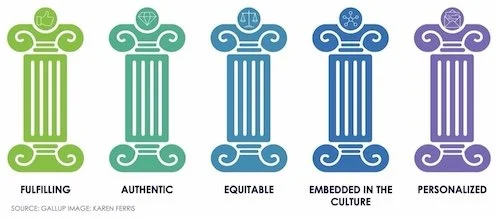
Fulfilling
This is about getting employee expectations right and ensuring the amount of recognition, appreciation and gratitude they get makes sense.
There is no golden rule about how often you should recognise someone, appreciate them and show gratitude. Every employee is different, and their needs vary. The objective should be a consistent and reliable experience that makes employees feel valued and their efforts validated.
This consistency applies to peers as well. Peer-to-peer validation often carries a unique weight because colleagues understand what it takes to get the job done each day.
I sincerely believe that there is no such thing as “too much” recognition, if it is authentic.
If you are unsure whether you are meeting the mark, ask your employees.
Authentic
Recognition, appreciation and gratitude must be authentic. They cannot be empty gestures. Employees can tell when there is a lack of authenticity, and when that happens, the desired impact is lost, and it undermines the experience.
Recognition, appreciation and gratitude only have impact when it means something to the recipient, about themselves, their role, their team and their organisation.
Whenever recognition, appreciation and gratitude are shown, the reason for it should be clear. It is not good enough to say, “good job.” You must tell the recipient how what they did, or how they behaved, had a positive impact.
It should also be timely. Spontaneous, in-the-moment feedback also reads as sincere.
Equitable
Recognition, appreciation and gratitude not only affect the recipient but also shape others' perceptions. When employees perceive recognition, appreciation and gratitude to be out of balance – particularly when they feel overlooked – it triggers emotions of unfairness and exclusion and adversely damages their employee experience.
Recognition, appreciation, and gratitude can reflect inclusivity and fairness in an organisation, or they can reveal serious attitudes and biases with adverse downstream repercussions.
Embedded in the culture
Recognition, appreciation and gratitude must become a way of life within the organisation. This is not a program or a set of practices. It is a 360-degree environment where everyone, regardless of hierarchy, feels fully empowered to offer feedback up, down, freely, and across the organisation.
Personalised
Recognition, appreciation and gratitude must be personalised. It must meet the recipient's needs. Preferences will vary in how and where employees receive feedback.
Even leaders need personalisation. A boss might prefer a quiet, private word of thanks from their team rather than an awkward public call-out.
If you are unsure about the “how and where,” ask them how they would like to receive it. Some people like the spotlight, while others avoid it at all costs.
Conclusion
Building an organisational culture of recognition, appreciation and gratitude is not a well-meaning project driven by HR.
It gives the organisation a sharp, competitive advantage.
As Kelleher demonstrated throughout his iconic career, business success is an inside-out phenomenon. When leaders consciously pause to recognise achievement, unconditionally value the human beings on their payroll, and nurture an environment of shared thankfulness, the numbers take care of themselves.
Start small today: pick one person on your team, find one specific thing they did exceptionally well, and tell them exactly why it mattered.