
When Efficiency Becomes Dangerous
Efficiency is a word echoing in every leader’s ears. “Do more with less.” “Achieve targets faster.” “Bring the project in ahead of time and within budget”
Leaders are being driven to adopt Artificial Intelligence (AI) with the stated aims of optimising, accelerating decision-making, automating, and building leaner teams.
On the surface, those seem like good objectives, but the danger lies in the fact that efficiency pursued without judgment will quietly shape behaviour, culture, and risk, often for the worse.
Efficiency vs effectiveness
Before I dive into the murky waters of efficiency, we need to be clear on the difference between efficiency and effectiveness. We often use them in close connection: “She is an efficient and effective leader.” Yet they are distinctly different.
I like the definition from Athena Captain:
1. Effectiveness: The Art of Achieving Purpose. Effective leadership is about achieving goals with precision and purpose. It’s the strategic navigation toward a defined mission, ensuring that every action contributes meaningfully. Effective leaders inspire, communicate a compelling vision, and guide their teams toward overarching objectives. Think of effectiveness as the compass that keeps the ship on course, aligning efforts with long-term success.
2. Efficiency: Streamlining Processes for Optimal Results. Efficiency, on the other hand, is the art of optimising processes to achieve results with the least possible resources. Efficient leaders focus on productivity, eliminating wasteful practices, and maximising output. They are adept at streamlining workflows, enhancing operational systems, and ensuring tasks are completed in the most resource-effective manner. Efficiency is the engine that propels the ship forward at maximum speed.
Efficient vs effective leaders
Efficient leaders are task-focused. They strive to meet targets, complete projects on time and within budget, and execute the strategy. They optimise resources, minimise waste, and seek immediate results. They are methodical, structured, and detail-oriented.
Effective leaders are impact-oriented, strategic and relational. They set a clear vision and inspire their teams. They motivate others to achieve desired outcomes.
Efficient and effective leaders
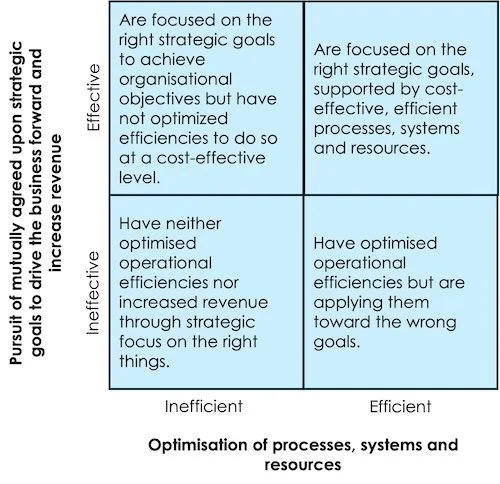
As Peter Drucker famously said in his 2007 publication, The Effective Executive, “Efficiency is doing things right; effectiveness is doing the right things.”
When a leader strikes the right balance between efficiency and effectiveness, they ensure that the right things are done in the right way.
The following matrix, adapted from Oracle NetSuite, illustrates the sweet spot in the top right-hand quadrant.
The danger
When the focus is on efficiency alone, there is danger. This focus on efficiency over effectiveness is driven by the hope placed in AI.
The Gartner CHRO Guide: 9 Future Work Trends for 2026 highlights the danger zone.
“CEOs, optimistic about AI potential, are initiating headcount reductions without the AI productivity gains to sustain them. But premature reductions will force companies to rehire talent later, likely at higher cost and with damaged trust.”
In 2025, we saw several large, high-profile layoffs that CEOs attributed to AI efficiency gains. These gains will not come.
Gartner reports that, despite the headlines, only 1% of layoffs in the first half of 2025 were attributable to AI increasing employee productivity.
The promise of efficiency has ignored effectiveness, resulting in the loss of critical talent and future challenges in rehiring top talent.
The Gartner report also refers to “AI workslop” becoming the organisation’s top productivity drain.
I had not heard the term workslop before reading the Gartner report, so a little research revealed that the term was coined by researchers at BetterUp Labs and the Stanford Social Media Lab and popularised in a September 2025 Harvard Business Review article to describe AI-generated content that appears polished but lacks the substance to meaningfully advance a given task.
According to Gartner, workslop is the result of employees being pressured to produce more, faster, with no time or autonomy to discern whether their work is high quality or fit for purpose. The impact is that each incidence of workslop takes nearly two hours to detect, diagnose, and fix. Effectiveness is lost in the pursuit of efficiency.
Automation bias and the erosion of self-trust
The rush to engage with AI for efficiency alone can erode self-trust. The Conversation reported in September 2025 that business leaders’ drive to adopt generative AI technologies stems from their prioritisation of efficiency over effectiveness.
It says that in the rush to adopt AI for efficiency, the real impact it can have on employees and company culture is being overlooked.
There are two main concerns raised.
Automation bias
“One of the most prominent effects is known as ‘automation bias.” Once AI is integrated into a company’s workflow, its outputs are often internalised as authoritative sources of truth.
Because AI-generated outputs appear fluent and objective, they can be accepted uncritically, creating an inflated sense of confidence and a dangerous illusion of competence.”
As noted earlier, this results in costly rework when hidden errors and hallucinations must be corrected.
Erosion of self-trust
“Continuous engagement with AI-generated content leads workers to second-guess their instincts and over-rely on AI guidance, often without realising it. Over time, work shifts from generating ideas to merely approving AI-generated ones. This results in the diminishing of personal judgment, creativity and original authorship.
Research has shown that trust and reliance on AI can lead people to follow advice that conflicts with available contextual information and is against their own interests.
Overreliance on AI advice undermines human cooperation, leading to undesirable outcomes. It also leads to inefficient outcomes for those being informed by AI.
Efficiency not only erodes self-trust but also judgment. Where efficiency rewards speed, judgement requires pause. When the priority is efficiency, any questions posed are perceived as unnecessary delays and as disagreement. Applying context is seen as unnecessary noise, and human nuance is treated as friction.
When this happens, leaders stop asking “Is this the right decision?” and start asking. “How quickly can we execute?”
Burnout
When AI is seen as a panacea for increased efficiency, burnout occurs as expectations for employees are unfairly raised.
According to the Upwork Research Institute, 96% of C-suite leaders expect AI to improve employee productivity, and 77% of employees report that AI has actually increased their workload.
Melissa Doman says that is not efficiency. It is employee burnout in disguise.
Dr Gabby Burlacu, Senior Research Manager at the Upwork Research Institute, said that whilst AI can deliver productivity gains, there is a more complex picture under the surface.
“We found that workers who are highly productive with AI are also the most likely to report signs of burnout and disconnection. This tells us that the conversation can’t stop at efficiency.
Productivity and well-being can’t be treated as trade-offs. Organisations that thrive in this new era will be the ones that take a more holistic approach to AI adoption, one that prioritises sustainable performance and human connection.”
These are organisations that prioritise effectiveness over efficiency and EI over AI.
Emotional intelligence to the rescue
Dangers can be averted when leaders possess Emotional intelligence (EI).
AI may be able to optimise, but it cannot judge the consequences. I wrote about the David-and-Goliath dynamics of EI and AI in my last newsletter, noting that EI does not defeat AI but rather governs the battlefield.
The slingshot moment is when a leader chooses to intervene. They do not kill the technology, but they direct it to their advantage.
This is the moment the leader with EI says:
· This decision needs context, not just data.
· This situation requires a conversation, not a system response.
· This may be efficient, but it isn’t right.
· This tool supports our people - it does not replace them.
EI is not a “soft” counterbalance to efficiency. It is the governor who halts the use of AI when it causes harm.
Emotional intelligence tells leaders when to pause rather than push, when to listen rather than default to automation, and when efficiency creates risk rather than advantage.
When the world is obsessed with efficiency and speed, a leader’s judgment and decision-making becomes the differentiator. EI is the enabler.
What leaders need to do
Acquire and utilise EI to inform decision-making that considers effectiveness as well as efficiency.
Leaders should not ask, “Is this the most efficient option?” but “What will this efficiency cost us, and who will pay the price?”
They need to do this because when efficiency becomes the primary goal, trust erodes, psychological safety collapses, and ethical blind spots widen. Leaders become managers of systems rather than stewards of their people.
Leaders must not only train themselves but also their employees to collaborate effectively with AI without overreliance on its outputs. As the Conversation says, “This requires systematic training in interpretive and critical skills to build balanced and ethical human-AI collaboration.”
There must be psychological safety that allows employees to question the use of AI and the validity of its output, without being accused of dissent. Employees should be encouraged to question.
Organisations that combine speed with discernment will weather uncertainty far better than those that treat AI like an autopilot. Speed moves you forward; judgment keeps you on course.
Wrap
The future of leadership will not belong to those who know how to harness technology to go fast, but those who know when not to.
Technology alone won’t determine success in the AI era. Leadership judgment and ethical thinking will.