
Remaining human is not enough
AI demands the elevation of human capability
I recently read an article that said we need to “remain human” in the AI era. I don’t believe that remaining human is enough. It suggests that we just stay the same as technology advances. The onslaught of AI does not warrant a passive response; it needs a more intentional one.
We need to elevate human capability.

Elevated capability
I often hear people saying that AI will augment what we do. But we need to augment AI to ensure that its cognitive work – once reserved for us – is guided by human judgement, shaped by human values, and governed by human accountability.
We have been disrupted by technology before. The printing press changed how we accessed knowledge and how far it could travel. Computers changed how we processed and stored information. The internet changed how we connected and how quickly information moved.
But we must acknowledge that AI is different. It does more than help us access or move information. It is increasingly taking on the cognitive tasks once reserved for us humans. It does the analysing, summarising, predicting, decision-making, creating, problem-solving, generating and recommending.
Therefore, the leadership challenge is no longer only about helping people adopt new tools. It is about ensuring that machine-generated outputs are guided, challenged and governed by elevated human capability.
This is why human capability is more important in the AI era. We need to elevate it so it becomes the safeguard, the differentiator, and the source of responsible leadership.
Elevated human capability is not only a leadership requirement; it is an organisational requirement. People at every level will need stronger judgement, curiosity, empathy, adaptability and ethical reasoning. Leaders must drive that shift by modelling these capabilities, creating space for their development and ensuring AI is used to strengthen, not diminish, human thinking.
Leadership human capability uplift
In the past, we have looked to our leaders for certainty, control, expertise, and efficiency. In the AI era, that is not enough.
Those capabilities had value, and in some contexts still do. Leaders need to understand the work, make decisions, manage risk, allocate resources and deliver outcomes. But, in an AI world, that alone is no longer enough.
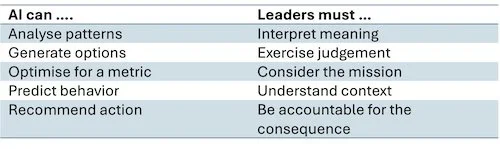
Often the leader saw their role as being the first person with an answer. When AI can analyse information, generate options, identify patterns and recommend actions, that leadership role no longer exists.
The leader’s role becomes asking whether the AI response is right, fair, and responsible. Leaders must ask if the response should be trusted, challenged, or acted on. The leadership imperative is to question the output, test the assumptions, consider the context, assess the consequences, and decide whether the action is human-centred, ethical and sound.
Leaders need curiosity to ask better questions rather than simply accept answers, empathy to understand the impact of decisions on their people, adaptability to keep learning how to lead as technology evolves, courage to challenge outputs that may appear efficient but will not be effective, and accountability because AI may provide a decision but cannot own the consequence.
Organisations cannot just invest heavily in AI and fail to invest in the human capability required to use it well. Those organisations will just be making faster decisions with weaker judgement, which is dangerous.
The human capabilities that AI cannot replace
The human capabilities we need to elevate are not new. They are the intrinsic qualities of effective leadership that I wrote about in Be REMARKABLE. But in the AI era, they take on greater significance.
When AI can generate answers quickly, leaders need resilience to stay steady in uncertainty, empathy to understand the human impact of decisions, and mindfulness to pause before reacting to machine-generated outputs.
They need adaptability to keep learning, unlearning and relearning as work changes. They need resourcefulness to find better ways to combine human and machine capability. They need to be known for credibility, consistency and trust, because people will look to leaders for confidence when technology creates ambiguity.
They need accountability because AI cannot own the consequences of a decision. They need bravery to challenge outputs that may appear efficient but are not ethical, fair or effective. They need listening to hear what the data does not reveal. And they need to be empowering, so people are encouraged to question, learn, contribute and think critically, rather than passively accept what AI produces.
These are not soft skills. They are the human infrastructure required for responsible leadership in an AI-enabled world.
Investment
Organisations are investing heavily in AI platforms, tools, training, governance and implementation. They are building roadmaps, allocating budgets, creating policies and redesigning workflows to take advantage of what AI can do.
But the same level of intention is not always being applied to elevating the human capability required to use AI well, and that is a risk.
If AI is going to analyse information, generate recommendations, support decisions and influence action, then people need the capability to question it, challenge it and apply it wisely. They need to know when to trust the output, when to interrogate it, when to override it and when to bring human judgement back into the centre of the decision.
Elevating human capability must be intentional. Judgement, curiosity, empathy, adaptability, ethical reasoning, listening and accountability need to be developed as deliberately as technical AI skills. People need opportunities to think critically, wrestle with complexity, test assumptions, reflect on consequences and learn from ambiguity.
AI does not remove those opportunities. But if leaders allow its outputs to be accepted without challenge, those opportunities may be bypassed. Organisations may gain speed but lose judgement.
We do not want to slow AI down, but we need to build human capability up to lead what AI makes possible.
This means leaders have a critical role to play. They must create environments where people are encouraged to ask better questions, challenge machine-generated outputs, consider human impact, and make decisions that are not only efficient but ethical, sound, and human-centred.
AI investment without human capability investment is incomplete. It may produce faster outputs, but not necessarily better outcomes.
The organisations that thrive in the AI era will not be the ones that simply adopt the most advanced technology. They will be the ones that elevate the human capability needed to use that technology responsibly.
Remaining human is not enough.
In the AI era, it is not enough just to simply remain human. We must become intentional about the human capabilities we elevate, develop, value and reward.
When AI generates answers, we need people to ask better questions. When AI analyses patterns and suggests actions, we need people who can interpret the context behind those patterns, understand what the data may not be revealing, and decide on what the consequences may be for the organisations and the people within them.
When AI optimises for efficiency, we need people who can recognise when efficiency is not the same as effectiveness. For example, AI might recommend reducing customer call times because shorter calls look more efficient. But if customers leave the call confused, frustrated or needing to call back again, the process may be efficient, but it is not effective.
These are the changes that leaders need to recognise as an imperative for organisational success.
Human capability cannot be treated as the soft side of AI transformation. It is the foundation that determines whether AI is used wisely, ethically and effectively.
The organisations that thrive will not be those that simply adopt AI the fastest. They will be those that elevate the human capability needed to guide it, challenge it and use it responsibly.
AI will change the way we work, but it will be our human capability that will determine the outcome.
AI will change the way we work, but we must shape the consequences
AI will keep getting faster.
This does not mean we should think less. It means we must think more effectively.
The organisations that thrive will be those that invest as intentionally in human capability as they do in artificial intelligence. Because in the end, AI may shape the work, but we humans must shape the consequences.