
Organisations are investing billions in AI…and seeing little return.
The technology works.
So, what’s going wrong?
The opening comments from Gallup CEO Jon Clifton in the State of the Global Workplace 2026 report should stop every executive in their tracks.
“The technology works. Large language models can draft legal contracts, write code and synthesize research at speeds no human team can match.
But those gains are not showing up in the bottom line.
A recent MIT study found that despite roughly $40 billion in enterprise investment, 95% of organizations have seen zero measurable impact on profits.1 An NBER survey of nearly 6,000 global executives reports that 89% see no effect on labour productivity. In Gallup's own data, only 12% of employees in AI-implemented organizations strongly agree that AI has transformed how work gets done in their organization. So, if the technology isn't the problem, what is?
Gallup's data points to an answer many organisations have avoided for years: the leader.”
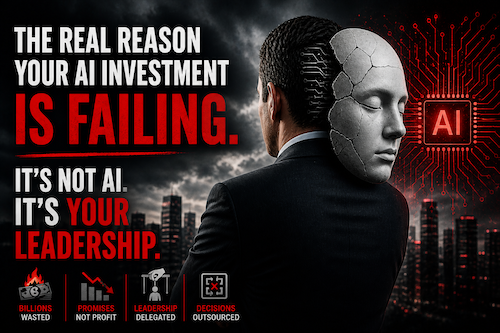
AI is exposing a leadership failure
Organisations have struggled with ineffective leadership for a long time, and many have buried the issue under the proverbial carpet. But now more is at stake.
For decades, the victims of poor leadership have been employees. Disengagement, frustration, anxiety, burnout were the real consequences but often tolerated.
Now, the impact is financial, and unfortunately it may carry more weight than the suffering of employees.
Massive investments in AI are delivering little or no return, as its success relies not just on the technology but also on how well you lead the employees who are to use it.
AI adoption failure is not a technology failure. It is a leadership failure.
Poor leadership is no longer just a people problem.
it is now a financial liability.
The financial implications are no longer theoretical - they are already being realised.
Organisations are investing heavily in AI, yet many are seeing little return on investment. In some cases, the impact is negative rather than neutral. EY estimates that companies have collectively incurred billions in losses linked to AI deployment, with $4.4 billion attributed to failed or poorly governed initiatives.
At the same time, most organisations are struggling to generate meaningful value. Research from BCG indicates that only a minority are achieving tangible returns, while PwC highlights that 75% of AI-driven financial gains are captured by just 20% of companies.
This creates a stark imbalance, where significant capital is committed, but the benefits are concentrated among a small number of organisations, leaving the majority with underperformance or loss.
The cost, however, extends beyond direct financial loss. Expected productivity gains are not being realised, work is duplicated or reworked, and decision quality is inconsistent. In many cases, organisations are not just failing to benefit from AI - they are absorbing additional operational cost.
The conclusion is difficult to ignore. This is not a technology failure.
It is a leadership failure.
Leadership has always had a cost. AI has simply made that cost visible.
Leadership debt
What we are seeing now is the compounding effect of something organisations have been carrying for years: Leadership debt.
AI is amplifying leadership debt.
Leadership debt is the accumulation of outdated leadership thinking, behaviours, and decisions that organisations carry. Just like technical debt, it builds quietly over time. Shortcuts are taken and difficult changes are avoided. The old ways of leading are preserved because they worked in the past.
Now they don't, and AI is exposing the issue.
Leadership debt in an AI world
You can see leadership debt clearly in the way organisations are approaching AI. Leaders continue to rely on command-and-control leadership models in an environment that demands innovation and experimentation. It is seen when leaders either avoid making decisions or defer to AI to do so.
Leadership debt is incurred when leaders rely on how they led in the past, even as the world is rapidly evolving. It increases when leaders talk about transformation but are unable to lead it.
What emerges is a façade in which leaders appear to be driving transformation, while continuing to operate from the same mindset and behaviours that created the need for transformation in the first place.
Leaders cannot lead a transformation until they transform themselves.
Augmented leadership vs outsourced leadership
AI presents leaders with a choice. They can augment leadership or outsource it.
Augmented leadership uses AI to enhance thinking. It seeks insights, applies judgments, questions outputs, and remains accountable.
Outsourced leadership does the opposite. It defers decisions to AI, accepts the outputs without questioning them, and avoids accountability.
Whilst you can delegate tasks to AI, you cannot delegate leadership.
The hard truth: leaders must unlearn
For many leaders, the challenge is not learning AI but unlearning how they lead in the world of AI and beyond.
They need to unlearn to rely on past success as proof of future relevance. They must unlearn transactional leadership models and relearn transformational leadership models.
They must unlearn that they do not always need to have the answer. They must unlearn to avoid difficult decisions and relearn to address them with the minds of the collective. They must unlearn equating control with efficiency and relearn equating empowerment with effectiveness.
They must unlearn evasion of outcomes and relearn personal accountability.
To paraphrase Adam Grant, they must have a growth mindset and the curiosity always to learn new ways to lead effectively. They must have the courage to unlearn and the humility to admit what they do not know today. They need the integrity to admit that they were wrong yesterday.
None of that sounds easy, but it is not an option if we are to address the leadership debt. Leaders must think differently, behave differently, and lead differently by letting go of what is no longer serving them.
We need cognitive friction
There is a growing risk in AI adoption.
Earlier in the year, I wrote about the AI and EI (emotional intelligence) battlefield, highlighting the risk of blindly adopting AI.
“The power of AI cannot be ignored. It can analyse vast amounts of information, detect patterns humans would never see, and execute tasks at a scale and speed that no organisation can ignore. Used well, it reduces cognitive load, improves consistency, and frees people from repetitive work.
But when something hits us with such force, it can lead to actions that have not been given due consideration. Leaders respond with knee-jerk reactions before they have had time to think.
Leaders will make rushed decisions and, without due consideration, acquire and adopt tools.
Technology gets deployed with little understanding, because leaders see other organisations doing it.
It is a frenzy driven by a fear of missing out. Analysis and conclusions are dangerously handed over to algorithms because they appear objective, neutral, and “smarter” than we mere humans.
The giant has established itself through momentum. This is when we need good leadership the most.
When leaders respond to power with fear, they are fighting on the giant’s terms of speed, automation and optimisation. Humans will never win that battle.
The leadership we need is not the one that asks not whether AI should be used, but where, when, and how. It is the leadership that decides where, when and how it is used.
This is the question defining the battlefield.”
We must not have efficiency without thinking, speed without judgement, outputs without questions, and automation without challenge.
We need cognitive friction. This is the deliberate act of questioning outputs, applying context, considering consequences, challenging assumptions, and being highly attuned to algorithmic bias.
AI can accelerate thinking, but it must not replace it.
Psychological debt
Leadership debt does not just impact performance, but it erodes the psychological foundations of the workplace. Leaders must understand how AI use can degrade employee motivation, corrupt collaboration and innovation, and increase levels of stress and burnout.
What we are now seeing is the emergence of psychological debt.
Guy Champniss, writing for Harvard Business Review, described the six forms of psychological debt. I highly recommend you read it.
Cognitive debt – loss of cognitive processing and decision-making skills.
Autonomy debt – loss of the ability to control how we work.
Competency debt – the more we use AI, the less competent we become.
Relatedness debt – AI usage decreases social interaction
Credibility debt – using AI creates a sense that users lose credibility with their colleagues.
Identity debt – people question their role and value.
These are not side effects. They are signals that leadership is not keeping pace with the environment it is trying to lead.
The change that is needed
If an organisation wants to realise the full value of AI without the psychological debt, it must shift its focus from better technology to better leadership.
We must invest in developing leaders who can lead in an AI-enabled world.
There must be decision-making frameworks that allow for human intervention and contextual judgment. Leaders must reinforce a simple but critical principle. AI is decision support, not a decision maker.
Leaders must encourage and oversee critical engagement, not passive adoption.
Above all, leaders must master themselves first. The ability to lead others through transformation begins with the willingness to transform yourself.
Final thoughts
AI is not the problem.
It is the amplifier.
It is exposing what organisations have ignored for years.
The technology is not failing.
Leadership is.
Where are you seeing leadership debt show up in your organisation?