
The Seniority Cliff: Who Will Be Ready in 2030?
When organisations automate entry-level work, they may also remove the learning ground where future senior talent is built.
A recent article from Cindy Rodriguez Constable, “How Leaders Are Automating Away Their Own Talent”, caught my attention as it named a concern I have been ruminating on.
There is currently a drive in many organisations to use AI to replace entry-level staff.
The recent statements from two financial executives show the writing is on the wall.
Goldman Sachs President and COO, John Waldron, publicly described his entire workforce as a “human assembly line” to be digitised.
Standard Chartered CEO Bill Winters described employees at risk of AI automation as “lower-value human capital.
My concern is the long-term impact of replacing all entry-level employees.
Constable says, “…the decisions executives are making today to optimize for this quarter are eroding the talent infrastructure they'll need a decade from now.”
The World Economic Forum's Future of Jobs Report 2025 found that 40% of employers expect to reduce their workforce where AI can automate tasks. The information sector's layoff rate has doubled over the past year to 2.4% - the sharpest increase of any industry - a trend that Indeed attributes in part to AI. Companies, including Block and Cisco, have cited AI directly when announcing headcount reductions.
“These are data points about a structural shift in how organisations are building - or failing to build - their talent pipelines”, writes Constable.
The Seniority Cliff
Researchers are calling this the Seniority Cliff. Seniority is not just your age or tenure, but the accumulated knowledge you have acquired over the years.
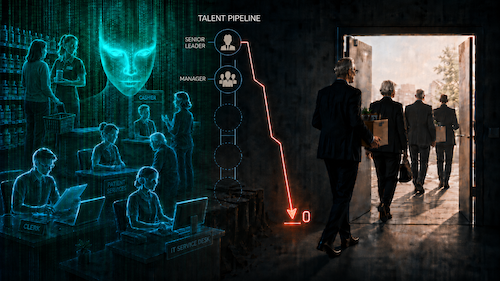
When we remove the base work that entry-level employees traditionally do, we remove the learning process. In five or ten years’ time, we will not have the senior talent that emerged from employees who worked on the front line, on the shop floor, at the front desk, in the call centre, on reception, on the service desk, etc. Many of the seasoned talent we have today learned their craft in rank-and-file roles.
It may look like great cost efficiency right now, but in a decade, the cost of having no talent to fill positions will bite back. This is not an AI problem.
The question leaders need to ask is not only, “What work can we automate?”
It is also, “Where will people learn the judgment, context and experience we will need later?”
Constable sums it up. “This is a leadership accountability question, not a technology one. AI did not decide to stop hiring entry-level workers. Leaders did.”
This is not an argument against automation. Many entry-level tasks should be automated. Repetitive, low-value and rules-based work can often be done faster and more consistently by technology.
But leaders need to distinguish between automating a task and removing a learning pathway.
Some entry-level roles are valuable not only because of the tasks they perform. They are valuable because they expose people to customers, operations, pressure, exceptions and context.
That is where future judgment is built.
I wanted to bring this situation to life by looking at five real-world scenarios in which automation may remove not just a task, but also the learning ground where our future talent is built.
Food retail
In 2030, a food retailer can hire a Store Manager, but the Store Manager will not have grown up within the business. A dashboard can show the prospective Store Manager which products move quickly, which promotions performed well, and where the stock gaps are.
But it cannot always explain why the shelf is still empty, why customers walk past the promotion, why stock shown as available cannot be found, or why a product that looks fine in the system is failing in the aisle.
Those insights often come from being close to the work. From filling shelves, handling stock, answering customer questions, seeing damaged packaging, watching confusion at the shelf edge, and noticing the daily workarounds that never make it into the system.
Some of that work can and should be automated. But if the role disappears completely, so does the exposure to customers, products, pressure, exceptions and store reality.
The risk is not that automation removes a task. The risk is that it removes the learning ground where future managers develop operational judgement.
Bank and financial services
In 2030, a bank can hire a Senior Risk Manager, Branch Leader, Customer Experience Manager or Compliance Lead, but they may not have grown up close to customers.
A dashboard can show the prospective leader how many customers defaulted, how many fraud alerts were triggered, how many complaints were lodged, or how many loan applications were declined.
But it cannot always explain why a customer sounded uncertain on the phone, why someone was reluctant to disclose financial hardship, why a fraud victim appeared to be following instructions, or why a technically compliant decision still felt wrong.
Those insights often come from being close to the work. From answering customer calls, working at the branch counter, processing applications, handling complaints, listening to anxious customers, identifying vulnerability, and noticing when the real issue is not the question being asked.
Some of that work can and should be automated. But if the role disappears completely, so does the exposure to customers, pressure, exceptions, vulnerability, risk and trust.
The risk is not that automation removes a task. The risk is that it removes the learning ground where future financial services leaders develop judgement about people, context and consequences.
Health and aged care administration
In 2030, a health or aged care provider can hire an Operations Manager, Practice Manager, Patient Services Lead or Aged Care Administrator. Still, they may not have grown up close to patients, residents and families.
A dashboard can show prospective leaders’ wait times, appointment volumes, occupancy rates, call-handling times, incidents, complaints, and staffing levels.
But it cannot always explain why a family member is anxious, why a resident is becoming distressed, why a patient keeps missing appointments, why reception is overwhelmed, or why a technically efficient process feels cold, confusing or unsafe to the people using it.
Those insights often come from being close to the work, from answering phones, greeting patients, managing appointments, handling upset families, supporting residents, solving small daily problems, and noticing when the system is creating friction for people who are already under stress.
Some of that work can and should be automated. But if the role disappears completely, so does exposure to patients, residents, and families, pressure, vulnerability, dignity, and care.
The risk is not that automation removes a task. The risk is that it removes the learning ground where future health and aged care leaders develop judgement about people, service, safety and humanity.
Professional services
In 2030, a professional services firm can hire a Senior Consultant, Partner, Legal Counsel, Audit Manager or Advisory Lead. Still, they may not have grown up doing the foundational work of the profession.
A dashboard can show utilisation, project profitability, document turnaround times, client satisfaction scores, review cycles and delivery milestones.
But it cannot always explain why a client is uneasy, why an assumption is flawed, why a document looks technically correct but misses the point, why a risk is buried in the detail, or why a recommendation will not land with the people expected to act on it.
Those insights often come from being close to the work. From conducting research, reviewing documents, preparing first drafts, checking evidence, sitting in client meetings, listening to senior practitioners, asking basic questions, and learning how judgment is formed through repetition, feedback and exposure.
Some of that work can and should be automated. But if the role disappears completely, so does the exposure to clients, ambiguity, trade-offs, standards, risk, context and professional judgement.
The risk is not that automation removes a task. The risk is that it removes the learning ground where future professional services leaders develop the judgement to advise, challenge, interpret and decide.
IT and service management
In 2030, an organisation can hire a Service Manager, Operations Lead, Incident Manager or Technology Leader. Still, they may not have grown up close to users and the frontline reality of service.
A dashboard can show ticket volumes, resolution times, incident trends, service availability, automation rates and customer satisfaction scores.
But it cannot always explain why users are frustrated, why the same issue keeps recurring, why a workaround has become normal, why a knowledge article is technically correct but unusable, or why a “resolved” ticket did not actually resolve the user’s problem.
Those insights often come from being close to the work. From answering service desk calls, triaging tickets, resetting passwords, diagnosing basic issues, escalating incidents, calming frustrated users, spotting patterns, and learning how technology problems affect real work.
Some of that work can and should be automated. But if the role disappears completely, so does the exposure to users, business impact, urgency, confusion, workarounds, service failure and operational reality.
The risk is not that automation removes a task. The risk is that it removes the learning ground where future IT and service management leaders develop judgement about service, systems, people and business consequences.
Conclusion
I am not saying stop automation. Many entry-level tasks can and should be automated. The repetitive, rules-based work can often be done faster, more consistently and more efficiently by technology.
What I am saying is that leaders need to understand what else disappears when those roles disappear.
Entry-level work is not just a cost. It is often the place where people first learn how customers behave, how systems fail, how pressure manifests, how exceptions are handled, and how judgment develops.
As I said upfront, leaders should not just ask, “Can we automate this task?”
They should ask, “What learning pathway disappears if we automate this role completely?”
The seniority cliff will not appear overnight. It will show up slowly, when organisations need experienced leaders who understand the work, the customer, the context and the consequences, and discover they have not built them.
Leaders must ensure that AI does not eliminate the experiences that prepare their people for the roles they will need to fill later.
Automate the task but preserve the learning.