Selective Flexibility: Control - Until It Gets Expensive
This week, I am interrupting my series of newsletters and videos on emotional intelligence to talk about something that is infuriating me.
We have all seen the headlines. The speculation is that organisations will encourage their employees to work from home because they care.
Employers beginning to allow WFH amid fuel crisis.
Iran conflict could put return to office on pause
US gas prices hit $4 per gallon for first time since 2022
Global fuel crisis pushes governments to promote work-from-home and demand cuts, says IEA
Double standards
Call me a cynic, but I see two things at play here. Many organisations claiming they are telling employees to work from home due to the fuel crisis are making out that they care about the financial impact on employees. These are the same organisations that have mandated that employees work in the office regardless of how long their commute is or whether they need to be there.
There has been no concern about the cost to employees resulting from the mandates, so why should that change now?
The other play is that organisations have mandated a return to the office citing a loss of productivity if they don’t.
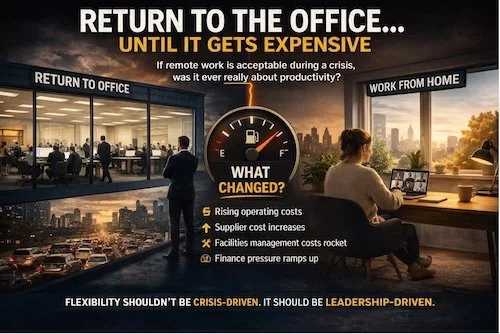
If remote work is acceptable during a crisis, was it ever really about productivity?
Flexibility when it suits the organisation
Many organisations have spent the last two years demanding a return to the office, arguing that work only really happens there. Now fuel prices rise due to the war in Iran, and suddenly organisations are saying, “Work from home if you can.”
So, which is it?
If employees can remain connected and work effectively and productively from home during a fuel crisis, then why couldn’t they do that before?
This is all about cost.
Welcome to Selective Flexibility
Selective Flexibility is when leaders enforce presence to maintain control, but only until the cost forces them to temporarily let go.
This isn’t flexibility.
It’s control - until control becomes too expensive.
This is not a people decision.
It’s a cost decision.
When organisations feel the cost, flexibility appears.
When employees feel the cost, mandates return.
That is selective flexibility.
Let me explain.
When the business starts to feel the pain of rising fuel prices, its behaviour changes.
When the organisation feels the cost
When fuel prices rise, the impact is not just felt by employees. It is felt across the business.
Operating costs increase when electricity, heating, cooling, and building systems costs rise.
Suppliers start charging more for cleaning, security, and maintenance as they pass on fuel-related cost increases. The office becomes expensive to run.
Facilities management contracts increase as they pass on fuel surcharges and equipment operating costs.
Catering and hospitality costs increase as food transport, supplier, and staffing costs rise.
Waste management is a fuel-heavy service, from collection and transport to processing, and providers are quick to increase fees.
Office usage is a target for cost reduction. Employers could reduce occupancy and reduce operating hours, but the easiest solution is to send everyone home.
Organisations don’t send people home because fuel is expensive. They send people home because the office becomes an inefficient, high-cost asset.
That is selective flexibility in action.
When the employee feels the cost
When the employees bear the cost of commuting, it is ignored.
Long commutes, fuel expenses, time lost, and personal stress were always there. Nothing about that is new. Yet organisations still wanted employees in the office.
Organisations ignored the truth that employees are no less productive when they work from home and mandated that they work in the office.
The organisation wasn’t feeling the cost – the employee was. But organisations wanted control.
When employees feel the cost, mandates return.
We have seen this before
We’ve been here before.
During COVID, organisations had no choice but to ask people to work from home. They did so at scale, for extended periods, and under pressure.
And what happened?
The work still got done. Productivity did not suffer; in fact, in many cases, it increased. There was still connection and collaboration. Employees were still engaged.
And then, as soon as the pandemic crisis subsided, many organisations pushed hard for a return to the office and for many, that push has resulted in mandates.
The push was not because working remotely failed, but because leaders were more comfortable with what they could see.
This is not new. We have seen it before. Every time it repeats itself, it exposes the same truth. The barrier is not capability, it is willingness.
The contradiction
Leaders didn’t lose control.
They lost visibility - and confused the two.
If employees can work effectively from home during a crisis, then they will always work effectively from home.
This exposes a leadership contradiction.
Leaders have said that employees need to be in the office to support culture, collaboration, connection, and productivity. But when a crisis hits, and leadership is concerned about outputs, they are happy to send them home!
If you read my newsletters and watch my videos, you will know the uncomfortable truth. The mandates were never about any of those things. They were about control.
They are about leaders who need to see people in the office to feel they are in control. They foolishly believe that when they see people, they are observing productivity. They equate seeing people with managing them. They are about leaders who do not know how to lead effectively when people are not in their immediate vicinity. They equate presence with performance. These leaders are not leading work; they are managing visibility.
They are leaders who are outdated, obsolete, and heading towards extinction – but not quickly enough. These leaders are like the dinosaurs that were already in decline before the massive asteroid struck Earth 66 million years ago. In the 10 million years prior to the impact, the number of species had already halved due to habitat loss. We can't afford to wait that long for these leaders to become extinct.
When the crisis ends
When the crisis ends, fuel prices will stabilise, the headlines will fade, and the disruption will cease. And then, quietly, many organisations will return to the same position as before the crisis.
Despite having proven that working from home does not affect productivity, culture, collaboration, or connection, leaders will once again demand a return to the office when the crisis is over. Not because anything has changed, but because the pressure has been removed.
And that is the real issue. We’ve already proven this works.
It was proven during COVID, and it will be proven again. Yet leaders will continue to ignore the blatantly obvious because of their need for control. The question to be asked is, “Why do we keep choosing to ignore it?”
Good leaders are not reactive. It does not swing between mandate and flexibility, and then back again, due to external pressure. Good leadership is consistent.
Good leadership will ask where, when and how our employees perform at their best. What work models motivate and engage our employees? How do we support our employees to perform at their best? How do we ensure the health and safety of our workforce? How do we provide employees with the flexibility to organise their professional life around their personal life rather than the other way around?
These are the leaders that people will trust and follow. Not because they have been told to, but because they are human leaders who treat people with respect, value their contributions, lead with empathy and compassion, listen to understand, and lead with humility and integrity.
These are the antitheses of the so-called leaders who prioritise visibility over value, presence over performance, and control over trust.
The real shift is not about working from home, but about how leaders think about work.
Willingness
This is no longer a question of capability. We already know the work can be done. We’ve seen it more than once. This is about choice.
It is about what leaders choose to prioritise. Do they prioritise visibility over value? Presence over performance? Control over trust?
The barrier does not sit with the system or the workforce; it sits with leadership.
The success of remote work is not new evidence. It is repeated evidence, and every time it is repeated, it exposes the same truth,
The barrier is not the leader's capability. It is the leader's willingness.
Because flexibility is not something that should appear only in a crisis, it is something leaders choose or choose not to.
If this is about choice, what makes leaders choose differently? They won’t change because they are shown the evidence; they already have that. They won’t change because we are telling them, we have already done that.
The change occurs when the cost becomes unavoidable. Disruption is clear to everyone, both inside and outside the organisation. Talent is departing, and performance is at risk. The change happens when the real impact hits them. This is precisely what is happening now.
But leaders have a choice. They can wait for the next crisis to force the decision, or they can make it intentionally.
Unlearning
The biggest challenge is unlearning the old ways of leading and relearning how to lead today. The leaders who will do that are the ones with the curiosity to learn, the courage to unlearn, the humility to admit what they don’t know today, and the integrity to admit they were wrong yesterday.
These are the leaders prepared to evolve as the world evolves. They must unlearn that presence equals performance, visibility equals outputs, and control equals leadership. These beliefs no longer serve them.
Flexibility is not a new idea, but it requires leaders to let go of how they have always led.
The future of work will not be defined by where people work. It will be defined by which leaders are willing to unlearn how they lead.
Final thought
This isn’t new evidence. It’s repeated evidence.
And every time it repeats, it exposes the same truth.
Flexibility doesn’t disappear. It becomes selective.
And selective flexibility is just control, waiting for a price tag.