
Beyond the Buzzword: Building Real Emotional Intelligence 3
The EI Advantage: Social Awareness
In this series of newsletters, I am exploring the four components of emotional intelligence (EI). My objective is to try to make it real and counter the eye rolling when it is mentioned. In my last newsletter, I said that while 90% of people think they are self-aware – the first component of emotional intelligence – only 10-15% are truly self-aware.
How do you know if you are emotionally intelligent? According to Harvard Professional and Executive Development, if you have high EI, you:
· Understand the links between your emotions and how you behave
· Remain calm and composed during stressful situations
· Can influence others toward a common goal
· Handle difficult people with tact and diplomacy
If you are any of the following, you have low EI. You:
· Often feel misunderstood
· Get easily upset
· Become overwhelmed by emotions
· Have problems being assertive
If you fall into that category, I suggest that this series of newsletters may help.
This week, I want to explore social awareness.
The four components
The four components of EI are:
· Self-awareness
· Self-management
· Social awareness
· Relationship management
Social awareness
Social awareness is a keen understanding of other people and their emotions. Additionally, it involves using this understanding to determine your interactions with the people around you. The emotional cues that people send you will help you empathise with them.
Robyn Hanley-Dafoe, writing in Psychology Today, describes social awareness as “the ability to read the room, see things from other people’s perspectives, sense and understand the emotional needs of others and show empathy.”
Good relationship management, the last EI component, relies on strong social awareness. Therefore, it is essential to get this right before proceeding to relationship management.
The truth is that a lack of social awareness can cause misunderstandings, conflicts, and relationship problems, while high social awareness is more likely to lead to healthier, more meaningful, and fulfilling relationships.
Why?
Your social competence (social awareness and relationship management) is your ability to understand other people’s moods, behaviour, and motives to respond effectively and improve the quality of your relationships.
Your social awareness is your ability to accurately pick up on emotions in others and understand what is truly going on.
When you have social awareness, you:
· Communicate more effectively
· Promote empathy, compassion, and understanding
· Build trust and connection
· Strengthen relationships
· Support constructive conflict resolution
· Facilitate effective leadership
· Improve team dynamics
How?
In the book Emotional Intelligence 2.0, Travis Bradbury and Jean Greaves provide 17 self-management strategies. Adapted from getstoryshots.com.
1. Greet people by their name. Using and remembering someone’s name is a simple yet effective way to engage with them. Visualise the individual’s name written out and mention it at least twice in your first conversation with them.
2. Observe body language. By becoming an expert at reading body language, you’ll be better able to recognise emotional cues and adapt accordingly.
3. Prioritise timing in your interactions. Pay attention to the other person’s emotional state and frame of mind, rather than your own, to determine the right moment to communicate your message. For instance, avoid asking for a favour when the other person is upset or angry.
4. Create a back-pocket question. Having a prepared open-ended question ready can be helpful when the conversation stalls, the other person becomes closed off, or you simply don’t know what to say. Use this when you need to revive the interaction, not in conversations that are already emotionally intense.
5. Don’t take notes during meetings. If you’re focused on notetaking, you may miss important cues in the conversation. Most communication is nonverbal, so whenever possible, you should focus on the individuals rather than your notes. If you need to take notes, ensure you take breaks at regular intervals to observe the people in the meeting and pick up emotional cues. Utilise AI tools to take notes for you.
6. Plan for social gatherings. It might seem a bit formal, but the truth is that planning helps you stay more emotionally present at the event. Write down the things you want to be sure to do, and you’ll forget less and notice more.
7. Clear away the clutter. This involves improving your listening skills by paying attention to the other person’s words and expressions, rather than thinking about what you want to say next. The key difference is your mental purpose: are you in the conversation to impress the other person with your knowledge, or to learn something?
8. Live in the moment. Being present wherever you are instead of wasting your time regretting the past and worrying about the future will allow you to be more perceptive of the people around you.
9. Take a 15-minute tour each day. Spend 15 minutes walking around and observing emotional cues: the appearance of people’s workstations, the timing of their movements, the general atmosphere, and so on.
10. Watch EI at the cinema. Take the time to view two films specifically to observe the characters' emotions, body language, relationships, interactions, etc.
11. Practice the art of listening. This involves consciously focusing on the speaker, paying attention to the tone, pace, and volume of their voice.
12. Go people-watching. To improve your social awareness skills, visit a coffee shop, grocery store, or other public places with the specific aim of observing people’s emotional states.
13. Understand the rules of the cultural game. In today’s world, being socially aware means developing emotional intelligence across all cultures worldwide. This is a complex task, as each culture has its own norms for personal, family, and business interactions. It will require patience as you observe and take extra time to grasp the cultural expectations of people outside your own culture.
14. Test for accuracy. If you’re unsure what a cue indicates about someone, you can always ask. Describe what you see (“You seem sad…”) and pose a direct question (“Did something happen?").
15. Practice empathy. Remember that people come from different backgrounds and have varied motivations. Put yourself in their situation and try to understand their perspective to see why they behave the way they do. When possible, check with them to verify if your assumptions are correct.
16. Consider the full picture. Ask others how they perceive you and gather feedback to understand how you come across.
17. Tune into the atmosphere of the room. Moving from focusing on individuals to accurately reading the overall mood is a significant step in developing your skills. You’ll likely have a gut instinct, but it's also useful to observe groups of people to see how they speak, move, and cluster. It can be beneficial to practice this alongside someone experienced in reading a room.
I would like to add one more: Do Not Assume. Do not assume you know why someone is behaving the way they are. Anything could have just happened, and your social awareness should be able to uncover that. There is a great short video called 20 Minutes Earlier which depicts people responding to another person’s behavior in a judgemental way not knowing what happened 20 minutes earlier. It is quite the eye-opener.
Making it real
Take the guidance out into the real world and apply it.
The pause
Start a conversation with someone using their name. In conversation, pause for a few seconds before responding. This is the period in which you observe facial expressions, watch body language, and note the tone of voice. Ask yourself if the person’s words match their nonverbal signals. This small pause can help identify subtle social cues that may contradict or enhance what is being said.
The map
When you are in a conversation, listen for emotional undertones. You can create a mental “emotion map” to help you respond to how the person is feeling, rather than what they are saying.
If someone says, “I have been assigned to a new project,” what is the undertone? Are they excited, scared, or anxious?
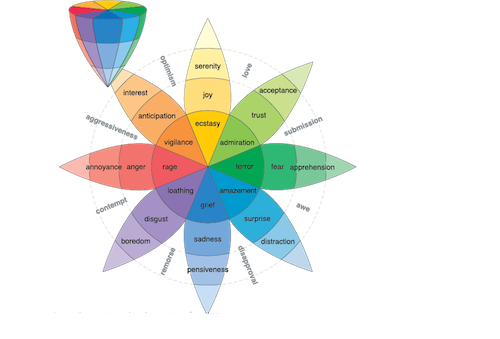
If you wish to enhance your understanding of emotions and/or create an emotion map for future reference, you can use Plutchik’s Wheel of Emotions.
Whilst there are many emotion maps, this is one of the most well-known. Robert Plutchik is a psychologist, and in his wheel, he divides the eight primary emotions and arranges them into opposite pairs, which include:
· Joy and sadness
· Fear and anger
· Anticipation and surprise
· Disgust and trust
His theory suggests that the eight primary emotions form the foundation of all other emotions.
Six Seconds describes the elements of the wheel.
Primary: The eight sectors are designed to indicate that there are eight primary emotions: anger, anticipation, joy, trust, fear, surprise, sadness and disgust. Primary emotions are located in the second circle.
Opposites: Each primary emotion has a polar opposite. See above.
Intensity: The cone’s vertical dimension represents intensity – emotions intensify as they move from the outside to the centre of the wheel, which is also indicated by the colour: The darker the shade, the more intense the emotion. For example, anger at its least level of intensity is annoyance. At its highest level of intensity, anger becomes rage. Alternatively, a feeling of boredom can intensify into loathing if left unchecked, which is a dark purple. This is an important rule to be aware of regarding emotions in relationships: If left unchecked, emotions can intensify.
Combinations: The emotions with no colour represent an emotion that is a mix of the two primary emotions. For example, anticipation and joy combine to be optimism. Joy and trust combine to be love. Emotions are often complex, and being able to recognise when a feeling is actually a combination of two or more distinct feelings is a helpful skill.
Source: https://www.6seconds.org/2025/02/06/plutchik-wheel-emotions/
You can enhance your emotional literacy by understanding how different emotions are interconnected and how they can evolve.
You can map the emotional undertones you detected in your conversation as a reference for the next conversation you have with the same person.
The technique
You must practice active listening to truly understand what is being said.
It enables you to listen to obtain information, listen to understand, and listen to learn. If you practice active listening, it means you are making a conscious effort to not only hear the words being spoken but, more importantly, the complete message that is being communicated.
You must stop talking. You cannot listen if you are talking. Listen rather than think about what you want to say. Give the other person your full and undivided attention.
Use nonverbal feedback, such as nodding, facial expressions, and appropriate body language, to reassure the person you are listening without needing to speak.
Avoid all distractions. You cannot allow yourself to be distracted by what is going on around you. This includes noise from incoming messages, phone calls, and emails. If you are checking messages while someone is talking to you, you are telling that person that they are not a priority, and you are not really interested in what they have to say.
You must give the speaker your undivided attention and acknowledge that you are listening by making eye contact.
Do not interrupt. Interrupting stops the other person from speaking. You cut them off. It is human nature to want to connect and help another person, but interrupting can harm the connection. You have shifted the focus of the conversation to you.
A process
As you train your brain by repeatedly practising new emotionally intelligent behaviours, your brain develops the pathways needed to make them into habits. Soon, you will start responding to your surroundings with emotional intelligence without even needing to think about it.
As your brain reinforces the use of new behaviours, the connections supporting old, destructive behaviours will weaken and fade.