Good Leaders Do Not Direct - They Provide Direction
In my last newsletter, I explored the need to reframe what constitutes good leadership and what it is not. It was inspired by a viral video from Nick Shackleton-Jones, who said that before the pandemic, leaders would strut the corridors in their suits and ties, feeling important. The office was their empire, and it was where they wore their crown. It was their identity, and they had a sense of self. Now they are lost and don't know what to do, apart from demanding that everyone return to the office to restore their kingdom.
It is time to wake up and understand what leadership is and is not.
I included these reframing statements and explored the need for clarity.
· Good leaders do not direct - they provide direction.
· Good leaders do not command - they provide clarity.
· Good leaders do not control - they build confidence.
· Good leaders do not dictate - they inspire dialogue.
· Good leaders do not manage people - they empower them.
This week, I want to explore providing direction over directing.
Command and control
When leaders direct, they micromanage. When leaders direct, they command and control.
Employees do not want to be managed; they want to be trusted. They don’t want to be commanded; they want to be guided.
As Stephen M.R. Covey says in this video, “Millennials do not want to be managed, they want to be led, they want to be inspired.”
I don’t think that is limited to millennials. I think most, if not all of us, want to be trusted and inspired. They want to be empowered. That does not happen when we are managed.
Leaders should manage things and lead people.
People often associate command and control with the military and interpret it as a black-and-white concept. Imagine if troops on the battlefield, under fire, had to await a face-to-face meeting with their commander to receive orders on what to do or wait for instructions via field communications.
Even today, with sophisticated telecommunication systems, the electromagnetic spectrum (EMS) can become overcrowded in warfare conditions. Therefore, communications can be limited.
At the core of the command philosophy in many military entities is “mission command.” Mission command aims to decentralise decision-making to the lowest possible level. Commanders issue orders before battle, specifying what they want the troops to do, but not how they should do it. This approach emphasises trust, commanders’ intent, and allows for decentralised execution, where subordinates can adapt to changing battle conditions.
Turn the ship around
I believe one of the best models of empowering leadership can be found in the publication “Turn the Ship Around!” by L. David Marquet.
Marquet was a Naval Academy graduate and an experienced officer when selected for submarine command. Trained to give orders in the traditional model of “know all–tell all” leadership, he faced a new wrinkle when he was shifted to the Santa Fe, a nuclear-powered submarine. Facing the high-stress environment of a sub where there’s little margin for error, he was determined to reverse the trends he found on the Santa Fe: poor morale, poor performance, and the worst retention rate in the fleet.
Almost immediately, Marquet ran into trouble when he unknowingly gave an impossible order, and his crew tried to follow it anyway. When he asked why, the answer was: “Because you told me to.” Marquet realised that while he had been trained for a different submarine, his crew had been trained to do what they were told - a deadly combination.”
This was the moment he turned the traditional leadership model of leader-follower into leader-leader. Despite struggling with the instinct to take control, he gave control to the crew and created leaders.
It did not take long for the crew to take responsibility for their actions at every level. They became leaders, motivated and engaged.
The Santa Fe went from worst to first, achieving the highest retention and operational standings in the Navy.
Things continued to improve after Captain Marquet departed from the Santa Fe. His leader-leader model resulted not only in Santa Fe winning more awards, but also in more officers and enlisted men being promoted to positions of increased responsibility than any other submarine, including ten who became submarine captains.
You can watch and listen to the story in this video.
Provide direction
Providing direction is not that hard. The hardest part is you.
You need to let go of control. You need to unlearn and relearn how to lead.
A newsletter I wrote in November 2022, titled “Do you have the courage to unlearn?”, explored the need for leaders who micromanage, control, disempower, and undermine trust to unlearn and relearn how to become a leader who is a coach, connector, conversationalist, caregiver, and cultivator.
I said, “Every leader must realise that what they have learned and lived by in the past will not support them in a leadership role now. They must embrace the concept of learning, unlearning, and relearning. They must recognise that some beliefs, behaviours, and practices need to be unlearned and new ones learned. This must be a continuous process that is undertaken to remain an effective leader. They must have courage.”
Prerequisites
There are two key prerequisites before empowering an employee: providing direction and autonomy. Empowerment means you enable your employees to own their roles and deliver outcomes. You trust them to make decisions. Autonomy means employees can manage their own work and decide on the best way to achieve their objectives.
The prerequisites for this are competency and clarity, which Captain Marquet referred to as the pillars of leadership.
Competence. You must ensure your employees can undertake the task(s) on hand. They must have the skills, knowledge, tools, information and support. You can still set a stretch goal for an employee, but it should be within their capability to achieve it. If the employee lacks competence, you are setting them up to fail, and that is cruel. You must provide training and development opportunities to equip employees with the skills and capabilities they need to achieve their future goals.
Clarity. This was the subject of my last newsletter. You define clear expectations and agree on outcomes, and allow your employee to determine how to deliver. You check understanding by asking questions and having your employee explain what they are expected to do. Remember, this is what they are going to do, not how they are going to do it. Clarity involves agreeing on what will be delivered and when it will be delivered. Your employee must be clear about the resources available to them, including any assigned budget. You must be clear that they have your full support and that you trust them. They are free to deliver however they want, even if that means experimenting and taking calculated risks.
The other prerequisite is psychological safety.
Psychological safety. If you are going to empower employees, you must also cultivate an environment in which they feel safe to speak up and speak out without fear of reprisal or repercussion. When there is psychological safety, employees feel secure enough to admit that they don't understand your direction, ask for help, and acknowledge that they have made a mistake. They know it is ok to have setbacks, and they should be seen as learning opportunities.
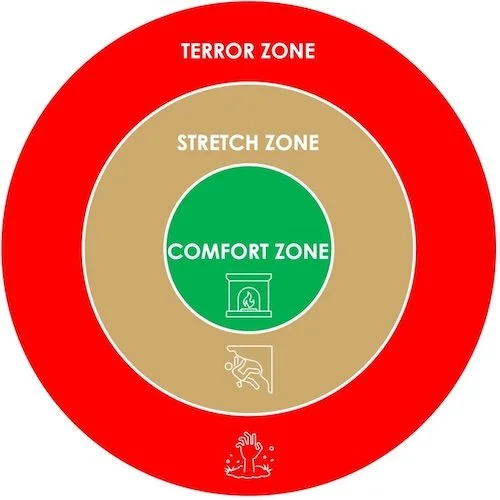
Empowering an employee and giving them autonomy without psychological safety will cause stress and anxiety. You will place them in the fear zone, which is where you do not want them to be. You want them to move out of their comfort zone and into the stretch zone. This is where they will take on new and challenging tasks. This is where the learning and growth happen. There will be feelings of nervousness and excitement.
In this zone, your employees know they are supported. You will push them into the terror zone (also known as the panic zone) when you ask them to undertake something well outside of their capabilities, when they do not have your support, and when they do not have psychological safety. Without psychological safety, they will be in fear of making a mistake with no safety net in place. This is where employees will be stressed, overwhelmed, fearful, and panicked. This hurts their physical and mental well-being.
Guardrails
A few years ago, I wrote an article exploring empowerment, autonomy and delegation. I discussed the need for clear parameters around decision-making so that employees do not feel they are being set up for failure. They have guidance regarding what decisions may require additional input. These are not strict “thou shalt do” and “thou shalt not” statements, but guidance for your employees when they are in doubt. It serves as a safety net, but individuals can choose whether to utilise it or not. I have revised the extract from that article to reflect my current thinking.
“Often, these are called guidelines or guardrails. Just as the guardrails on the road are there to prevent us from going off the road, guardrails around decision-making are there to help us when making what could be risky decisions.
How do your employees know what decisions they can make?
You can apply the ‘Waterline Principle’ instituted by American engineer and entrepreneur Bill Gore, the co-founder of W.L. Gore and Associates, the maker of innovative products such as Gore-Tex fabrics.
Imagine your organisation is a ship and you are the captain. You can empower employees to make decisions if they are shooting above the waterline. The decisions won’t sink the ship, so the risk can be sanctioned. If the decision goes awry and results in a hole in the side of the ship above the waterline, it can be fixed.
If the decision is to shoot below the waterline, it involves a risk, as it could create a hole in the submerged side of the ship. Decisions below the waterline need careful consideration, and when in doubt, they should be referred to the ‘captain’ so that the risk can be assessed and the appropriate decision made.
“As the captain, you can also define where the waterline sits based on factors including an employee’s position, experience, and level of expertise. A junior employee may have a different waterline than that of your senior managers.”
In the video, Captain Marquet stated that he only retained one order, which was to launch a weapon. That was because the order could result in loss of life, and he didn’t want that on anyone’s conscience other than his.
He also discussed providing intent rather than issuing instructions. He asks a crew member, “What are we trying to accomplish?” The crew member replies, “We are trying to get into position so that when the enemy submarine comes through…” The Captain asks, “Where do you think we should position the ship?” “Over here?” suggests the crew member, to which the Captain says, “Good idea. Go there.”
He doesn’t instruct; he provides intent, and the crew member, who likely knows more about the situation than the Captain does, comes up with the right solution.
The authority is moved to where the information is.
Magic happens
I work with leaders and leadership teams to transition them from a position of command and control to one of empowerment and trust, and I observe the impact this has on both the leader and their team. The team become engaged, inspired, motivated, and has a sense of purpose. The leader gets back time to do the things a leader should do.
Good leaders empower people; they do not manage them.